

Joenja results
For children aged 4-111
Pediatric patients aged 4+ saw meaningful improvements with Joenja1
Jump to section:

Clinical trial design
Co-primary end points demonstrated
Additional efficacy outcomes
Safety
Joenja was studied in 2 parts1-4:
- Part 1 was conducted over 12 weeks (N=6) and was a nonrandomized, open-label, dose-finding study in 6 patients with APDS; the dose range was 10 mg, 30 mg, and 70 mg BID for 4 weeks at each dose, and an oral dose of 70 mg BID was selected for Part 22,3
- Part 2 was an efficacy and safety evaluation with a randomized period of 12 weeks (N=31) and was a triple-blinded (patient, caregiver, investigator), placebo-controlled, fixed-dose study of 70 mg BID, with co-primary efficacy end points of improvement in lymphoproliferation and normalization of immunophenotype, assessed by change from baseline in the log10-transformed SPD of index lesions and change from baseline in percentage of naïve B cells out of total B cells, along with secondary and exploratory end point assessments and safety assessment1,4
Improvements were observed in both lymphadenopathy and B-cell function across all age groups studied. In the adolescent and adult trial (ages 12+), Joenja showed significant improvements across both end points, including normalization of naïve B-cell levels by week 4, maintained through week 12, and a significant mean reduction in lymphadenopathy by 46% from baseline.1,2,4,5
Joenja safety results in the randomized, placebo-controlled pivotal study showed that no serious adverse drug reactions were reported, no patients withdrew due to an adverse drug reaction, and the most common adverse reactions (>10%) were headache, sinusitis, and dermatitis atopic.1,4

CLINICAL TRIAL DESIGN
How Joenja was studied in children 4-11 years of age1,6

Duration
12 weeks

Participants
21 patients

Age
Patients 4-11

Study design
- Phase 3, 12-week, multinational, open-label, single-arm study of pediatric patients ages 4-11 (N=21) who weighed ≥28 lb and <100 lb (≥13 kg and <45 kg) at baseline with pathogenic variants in PIK3CD or PIK3R1; dose range was 20-70 mg orally, twice daily, based on body weight in the 1-year extension
- Co-primary end points:
- Change from baseline in log10-transformed SPD of index lymph nodes
- Change from baseline in percentage of naïve B cells out of total B cells
- Additional outcomes:
- Changes in B- and T-cell subsets, Ig levels, and spleen volume
- Safety assessment
Baseline demographic and disease characteristics in pediatric patients with APDS6
Patient Characteristic
Joenja
(n=21)
Age, median (range), y
7.0 (4-11)
Sex, male-to-female ratio, n
13:8
Self-identified race, n (%)
White
Asian
Other
Not reported/unknown/missing
9 (42.9)
4 (19.0)
1 (4.8)
7 (33.3)
Self-identified ethnicity, n (%)
Hispanic
Non-Hispanic
Not reported
3 (14.3)
12 (57.1)
6 (28.6)
Weight at baseline, median (range), kg
23.9 (15.4-44.5)
Time since APDS diagnosis, median (range), mo
32.9 (2.2-142.2)
APDS variant classification, n (%)
PIK3CD
PIK3R1
17 (81.0)
4 (19.0)
Treatment compliance, %
91.0
Medical History
System Organ Class & Preferred Term
No. of Patients
(%)
Infections & Infestations
Otis media
Pneumonia
Sinusitis
15 (71.4)
4 (19.0)
3 (14.3)
3 (14.3)
Respiratory, thoracic, and mediastinal disorders
Bronchiectasis
Asthma
14 (66.7)
7 (33.3)
4 (19.0)
Gastrointestinal disorders
Abdominal pain
9 (42.9)
3 (14.3)
Blood and lymphatic system disorders
Lymphadenopathy
Splenomegaly
8 (38.1)
4 (19.0)
3 (14.3)
Surgical & medical procedures
Tonsillectomy
Ear tube insertion
Adenoidectomy
8 (38.1)
6 (28.6)
5 (23.8)
4 (19.0)
Skin and subcutaneous tissue disorders*
6 (28.6)
Investigations†
3 (14.3)
APDS, activated PI3Kδ syndrome; Ig, immunoglobulin; SPD, sum of product diameters.6
*
Most common disorder within this category was dry skin in 2 patients (9.5%).6
†
Bone marrow biopsy, cardiac murmur, and tuberculin test positive were reported in 1 patient each (4.8%).6
CO-PRIMARY END POINTS DEMONSTRATED
Joenja helped normalize the immune system in children with APDS1,5,6
Improvements with Joenja were seen across all age groups at week 12 in both lymphadenopathy and naïve B cells
For lymphadenopathy, results were consistent with those seen in patients 12+ years of age
Reduction in lymphadenopathy1,5,6
n=19

33.8%
MEAN REDUCTION IN LYMPHADENOPATHY FROM BASELINE
Increased naïve B cells1,5,6
n=11
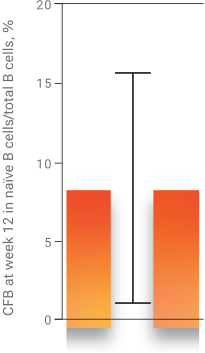
8.6%
MEAN INCREASE IN NAÏVE B CELLS FROM BASELINE
Descriptive statistics were used for the analyses of efficacy and safety in this study.
The results shown in the pediatric trial are supportive of those demonstrated in the adolescent & adult trial6
APDS, activated PI3Kδ syndrome; CFB, change from baseline; SPD, sum of product diameters.
ADDITIONAL EFFICACY OUTCOMES
Joenja reduced splenomegaly in pediatric patients ages 4-116
During the clinical trial, patients saw a reduction in spleen volume consistent with the adolescent & adult trial6
- At week 12, mean spleen volume decreased to 176.60 cm³ from 236.30 cm³ (n=21)
- Descriptive statistics were used for the analyses of efficacy and safety in this study.
Reduction in splenomegaly
n=21
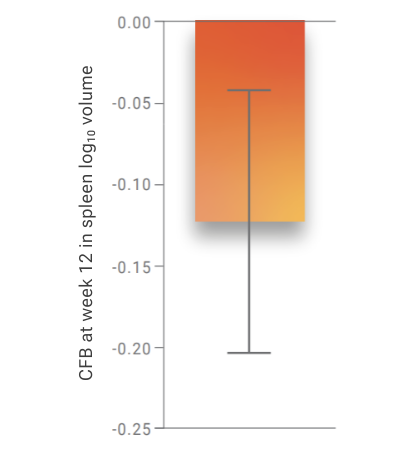
~25%
MEAN REDUCTION IN SPLEEN
VOLUME AT WEEK 12 FROM BASELINE
Joenja is the only FDA-approved treatment for APDS designed to help normalize the immune system by targeting the underlying immune defect1,4,7,8
APDS, activated PI3Kδ syndrome; CFB, change from baseline; FDA, Food and Drug Administration.
SAFETY
Joenja safety results in the pediatric trial
- No serious adverse drug reactions were reported2
- No patients discontinued due to an adverse drug reaction6
- Twenty patients had treatment-emergent adverse reactions6
- All were grade 1 or 2, with the majority reported as infections (52.4%) or gastrointestinal disorders (47.6%)
- None were serious
Most common adverse reactions reported in ≥10% of patients6
Joenja
n (%)
Infections & Infestations
Sinusitis
11 (52.4)
3 (14.3)
Gastrointestinal disorders
Vomiting
Diarrhea
10 (47.6)
4 (19.0)
3 (14.3)
Nervous system disorders
Headache
7 (33.3)
6 (28.6)
General disorders & administration site conditions
Pyrexia
6 (28.6)
4 (19.0)
Respiratory, thoracic, and mediastinal disorders
Cough
4 (19.0)
4 (19.0)
Skin & subcutaneous tissue disorders*
4 (19.0)
The safety results of Joenja for children 4 to 11 years old with APDS in the clinical trial were consistent with the safety results seen in the adolescent and adult clinical trial6
APDS, activated PI3Kδ syndrome.
*
Most common AE under this category was pruritus in 2 patients (9.5%).6
Dosing & administration
→
Contact a rep
→
References: 1. Joenja (leniolisib). Prescribing information. Pharming Healthcare, Inc. 2. Rao VK, Kulm E, Šedivá A, et al. Interim analysis: open-label extension study of leniolisib for patients with APDS. J Allergy Clin Immunol. 2024;153(1):265-274.e9. doi:10.1016/j.jaci.2023.09.032 3. Rao VK, Webster S, Dalm VASH, et al. Effective “activated PI3Kδ syndrome”—targeted therapy with the PI3Kδ inhibitor leniolisib. Blood. 2017;130(21):2307-2316. doi:10.1182/blood-2017-08-80119 4. Rao VK, Webster S, Šedivá A, et al. A randomized, placebo-controlled phase 3 trial of the PI3Kδ inhibitor leniolisib for activated PI3Kδ syndrome. Blood. 2023;141(9):971-983. doi:10.1182/blood.2022018546 5. Data on file. Pharming Healthcare, Inc. 6. Rao VK, Butte MJ, Neven B, et al. Primary and safety outcomes of a phase 3 open-label, single-arm, 12-week study of treatment with PI3Kδ inhibitor leniolisib in pediatric patients aged 4-11 years with activated PI3Kδ syndrome (APDS). Poster presented at: Clinical Immunology Society Annual Meeting; May 1-4, 2025; Philadelphia, PA. 7. Rao VK, Webster S, Šedivá A, et al. A randomized, placebo-controlled phase 3 trial of the PI3Kδ inhibitor leniolisib for activated PI3Kδ syndrome. Supplemental. Blood. 2023;141(9):971-983. doi:10.1182/blood.2022018546 8. Pharming Group. Pharming announces US FDA approval of Joenja (leniolisib) as the first and only treatment indicated for APDS. Press release. March 24, 2023. Accessed June 8, 2026. https://www.pharming.com/news/pharming-announces-us-fda-approval-joenja-leniolisib-first-and-only-treatment-indicated-apds