


Joenja safety profile
Joenja was shown to be safe and well tolerated across all age groups
Jump to section:

Pivotal trial safety (ages 12+)
Safety from peds trial (ages 4-11)
OLE safety data
Additional findings from the OLE study

PIVOTAL TRIAL SAFETY (AGES 12+)
Clinically proven tolerability: Joenja demonstrated a favorable safety profile, similar to placebo
Treatment was well tolerated, with no serious adverse events or patient withdrawals reported
Adverse reactions reported by ≥2 Joenja-treated patients and more frequently than placebo
- No serious adverse drug reactions were reported
- No patients withdrew due to an adverse drug reaction
- The most common adverse reactions (>10%) were headache, sinusitis, and dermatitis atopic
Joenja
(n=21)
n (%)
Placebo
(n=10)
n (%)
Headache
5 (24%)
2 (20%)
Sinusitis
4 (19%)
0 (0%)
Dermatitis atopic*
3 (14%)
0 (0%)
Tachycardia†
2 (10%)
0 (0%)
Diarrhea
2 (10%)
0 (0%)
Fatigue
2 (10%)
1 (10%)
Pyrexia
2 (10%)
0 (0%)
Back pain
2 (10%)
0 (0%)
Neck pain
2 (10%)
0 (0%)
Alopecia
2 (10%)
0 (0%)
*
Dermatitis atopic: including dermatitis atopic and eczema.
†
Tachycardia: including tachycardia and sinus tachycardia.
SAFETY FROM PEDS TRIAL (AGES 4-11)
Joenja was well tolerated in the pediatric trial
Most common adverse reactions reported in ≥10% of patients
- No serious adverse drug reactions were reported
- No patients discontinued due to an adverse drug reaction
- Twenty patients had treatment-emergent adverse reactions
- All were grade 1 or 2, with the majority reported as infections (52.4%) or gastrointestinal disorders (47.6%)
- None were serious
Incidence
n (%)
Infections & Infestations
Sinusitis
11 (52.4)
3 (14.3)
Gastrointestinal disorders
Vomiting
Diarrhea
10 (47.6)
4 (19.0)
3 (14.3)
Nervous system disorders
Headache
7 (33.3)
6 (28.6)
General disorders & administration site conditions
Pyrexia
6 (28.6)
4 (19.0)
Respiratory, thoracic, and mediastinal disorders
Sinusitis
4 (19.0)
4 (19.0)
Skin & subcutaneous tissue disorders
4 (19.0)
OLE SAFETY DATA
Additional safety results from final analysis
Joenja was well tolerated among pediatric patients
At the data cutoff
- 37 patients received Joenja 70 mg orally twice daily for at least 1 year, 31 patients for 2 years, and 10 patients for at least 5 years
- Median duration of Joenja treatment was 4.3 years (range: 1.2 to 7 years)
- 10 patients had more than 5 years of Joenja exposure
Joenja
n=37
COVID-19 negative
15
COVID-19 positive
12
Upper respiratory tract infection
10
Pyrexia
9
Headache
8
- 34 of 37 patients had ≥1 AE (333 AEs reported)
- 87% of AEs were grade 1, 48.6% were grade 2, and 27% were grade 3
- 1 grade 4 AE was reported
- 1 patient who had a grade 5 AE with significant baseline comorbidities suffered cardiac arrest resulting in death on day 879; investigator determined that the death was not related to study drug
- No serious AEs were related to Joenja treatment
- The AEs reported as related to study drug were weight increase (3 patients), arthralgia (1 patient), hyperglycemia (1 patient), and decreased neutrophil count (1 patient)
ADDITIONAL FINDINGS FROM THE OLE STUDY
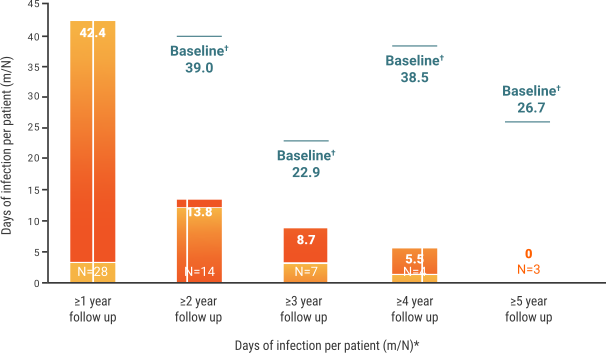
Annual infection rates
Infection rates reported per each additional year of treatment with Joenja
- Infections that developed during the study were reported as AEs. Investigators were requested to inquire about signs and symptoms of infections at each visit, in particular bacterial enterocolitis
- Patients were not provided an infection diary to document infections occurring between visits
- No change in antibiotic use was seen despite the reduction in IRT utilization
- Although safety was the primary objective of the open-label extension (OLE) study, this post hoc analysis from the OLE study was not powered to provide any statistical significance of efficacy; therefore, no conclusions should be drawn
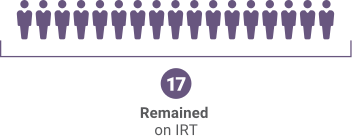
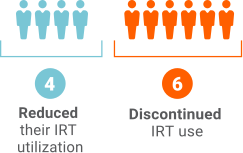
Physician-reported IRT reductions and discontinuations
- Data on concomitant medication usage were recorded at each patient visit
- Four patients had been IRT free for 1 to 2.5 years‡
- The median time to IRT reduction was 12.1 months, and the median time to IRT discontinuation was 11.9 months
Twenty-seven Joenja patients were receiving IRT at the start of the OLE study
AT THE DATA CUTOFF
*
m/N, number of infection days/number of patients in follow-up category.
†
Baseline infections are each group’s year 1 annualized rate of infections. N values changed because patients were in the study for different lengths of time.
‡
One of these patients had a subsequent one-time dose of IRT.
Data analyzed using a log-linear negative binomial model including an offset for time spent in study, an effect for time of the start of infection (in years), and presence of baseline infection as a covariate. One patient was excluded from the analysis due to a wrong year recorded for an infection.
IRT use was captured by the investigator as concomitant medication at each study visit per protocol in this open-label study. IRT was not prespecified as an end point or analysis. This is an observation from a post hoc analysis, and no determination of statistical significance can be made and no conclusions should be drawn.
Dosing & administration
→
Contact a rep
→